If you’re running a growing business, at some point you’ll ask yourself:
“Should I hire an in-house accountant… or outsource to virtual accounting services?”
It’s a fair question, and the answer isn’t always obvious.
Both options can work. But depending on your budget, growth stage, and operational needs, one will likely make more sense than the other.
Let’s break it down honestly.
What Are Virtual Accounting Services?
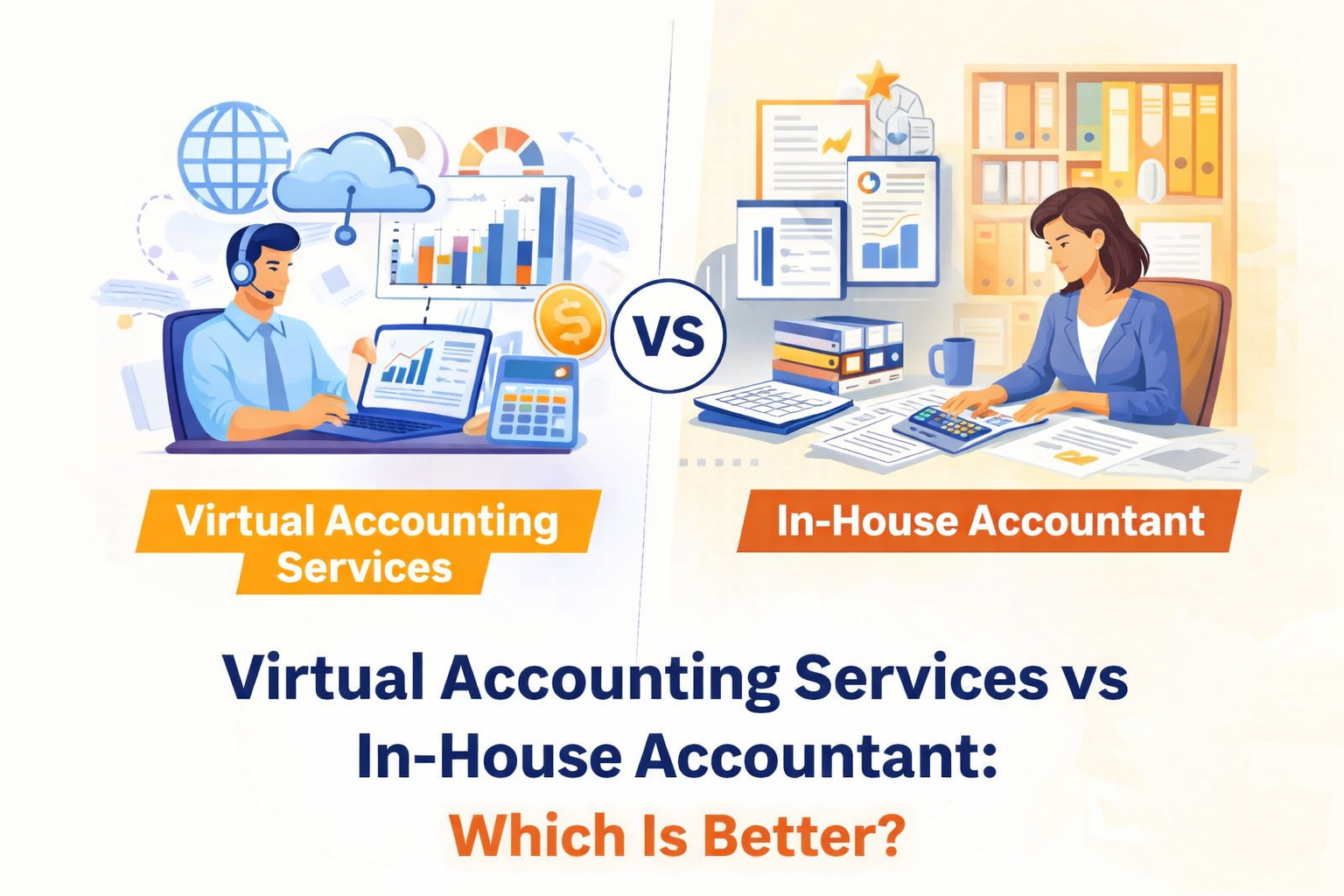
Virtual accounting services are professional accounting solutions delivered remotely. Instead of hiring someone full-time, you partner with an external accounting team that handles your bookkeeping, tax compliance, payroll, financial reporting, and sometimes even CFO-level advisory.
You’re not hiring a person, you’re gaining access to a team.
Most virtual accounting firms work through secure cloud systems, so you can see your numbers in real time without needing someone physically in your office.
What Does an In-House Accountant Offer?
An in-house accountant is a full-time employee working within your company. They manage your day-to-day financial tasks and are physically present to support your operations.
This setup can feel more controlled and hands-on. You have someone at your desk when you need them.
But that convenience comes at a cost, and sometimes, limitations.
Let’s Talk About Cost (Because It Matters)
Hiring an in-house accountant in the U.S. doesn’t just mean paying a salary.
You’re also covering:
- Benefits
- Payroll taxes
- Office space
- Software
- Training
- Equipment
A mid-level accountant can easily cost $80,000 to $120,000 per year when everything is included.
With virtual accounting services, you typically pay a fixed monthly fee. No benefits. No HR overhead. No office expense.
For many small and mid-sized businesses, that translates into 30–50% savings — without sacrificing quality.
Expertise: One Person vs a Team
When you hire in-house, you’re relying on one individual’s experience.
They may be excellent at bookkeeping but not strong in tax strategy. Or good at reporting but not confident in financial forecasting.
With virtual accounting services, you often get access to multiple professionals , bookkeepers, tax specialists, senior accountants, sometimes even CFO-level advisors.
That breadth of expertise can make a big difference as your business grows.
Scalability and Flexibility
Business isn’t static.
You might be steady today, expanding next year, or launching a new product in six months.
An in-house accountant is a fixed cost. If your workload increases, you may need to hire again.
Virtual accounting services are more flexible. You can scale up or down depending on your needs. That flexibility is especially valuable for startups and growing SMEs.
Technology and Efficiency
Many virtual accounting firms operate using modern cloud-based systems, automated reporting tools, and integrated dashboards.
You get real-time financial visibility instead of waiting for monthly summaries.
If your in-house setup relies heavily on manual processes or outdated systems, you may actually lose efficiency over time.
When Is an In-House Accountant the Better Choice?
There are situations where hiring internally makes sense:
- You’re a large enterprise with complex daily transactions
- You require constant on-site financial supervision
- Your industry demands heavy internal documentation
- You have the budget to build a full finance department
For bigger organizations, an internal team can be essential.
When Virtual Accounting Services Make More Sense
For many businesses — especially startups and SMEs — virtual accounting services offer a smarter approach.
They’re ideal if:
- You want to reduce overhead
- You need reliable compliance support
- You want access to broader expertise
- You prefer scalable solutions
- You operate remotely or across multiple locations
Instead of maintaining fixed payroll costs, you invest in a flexible partnership.
So, Which Is Better?
There isn’t a universal answer.
But for most growing businesses, virtual accounting services provide better value, greater flexibility, and access to stronger expertise, without the financial burden of hiring full-time staff.
Large enterprises may still need in-house teams. However, even many larger firms combine internal staff with outsourced advisory support for specialized expertise.
The key is aligning your accounting structure with your growth strategy — not just your current workload.
Final Thought
Your accounting setup isn’t just about bookkeeping. It affects compliance, cash flow, tax planning, and long-term profitability.
Whether you choose an in-house accountant or virtual accounting services, the goal should be the same: financial clarity, efficiency, and confident decision-making.
If you’re evaluating your options, start by asking:
- Can we reduce costs without reducing quality?
- Do we need one accountant — or a finance team?
- Are we planning for where the business is going, not just where it is today?
The right structure today can shape your growth tomorrow.