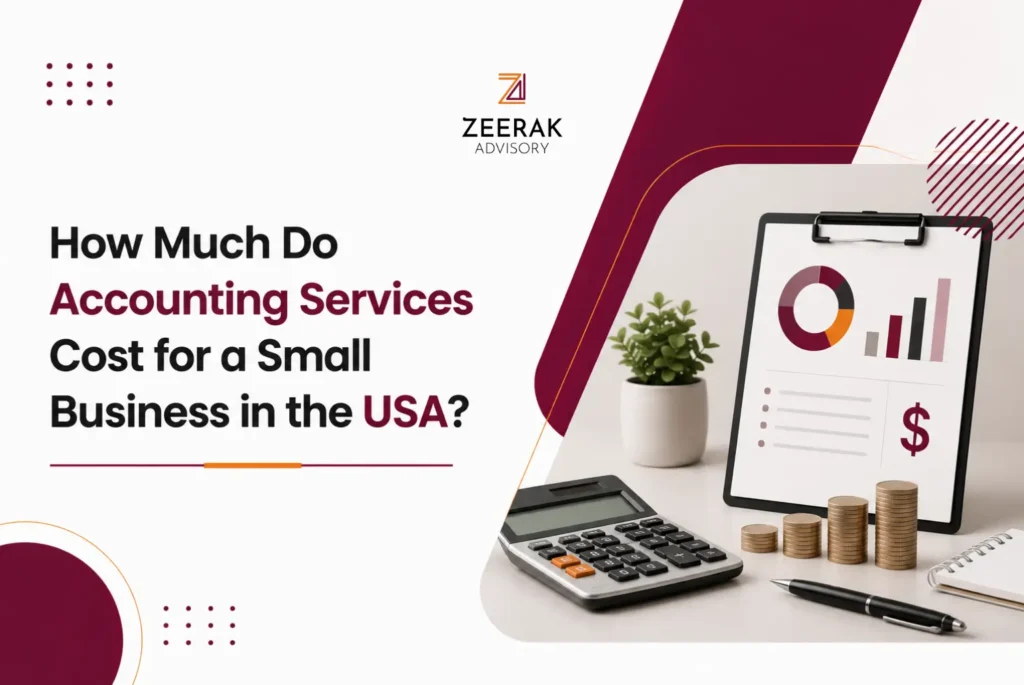
Accounting services for a small business in the USA usually cost $300 to $2,500+ per month, depending on bookkeeping volume, payroll, tax filing, reporting needs, business structure, and advisory support.
A simple solo business may only need monthly bookkeeping and annual tax preparation. A growing business may need bookkeeping, payroll, sales tax filing, financial reporting, CPA tax planning, and outsourced accounting services. The cost changes because the work changes.
Public pricing discussions show wide variation. One small business owner on Reddit described paying $450 per month for tax guidance, annual federal and state filings, payroll, and bookkeeping for a single-employee LLC taxed as an S-Corp. Professional accounting firms also publish wide ranges. The Fino Partners states that small business accounting services often range from $1,000 to $5,000 per year for basic accounting, while monthly service packages commonly range from $500 to $2,000 per month based on size and complexity. SK Financial states that CPA hourly rates often range from $200 to $450, while many monthly CPA retainers range from $250 to $900+ depending on support level.
The practical answer is simple: small business accounting services cost less when records are clean, transactions are low, and services are limited. Accounting fees increase when the business needs payroll, tax planning, cleanup bookkeeping, multi-state compliance, financial reporting, or advisory support.
What Is Included in Small Business Accounting Services?
Small business accounting services include bookkeeping, bank reconciliation, payroll support, tax preparation, financial reporting, sales tax filing, and accounting advisory, depending on the package.
Good accounting does more than keep records organized. It helps business owners monitor revenue, track expenses, prepare tax returns, manage cash flow, and understand business performance.
| Accounting Service | What It Includes | Cost Impact |
| Bookkeeping | Transaction coding, bank feeds, reconciliations | Low to medium |
| Payroll support | Employee payroll, payroll tax coordination, W-2 support | Medium |
| Tax preparation | Federal and state business tax returns | Medium to high |
| Financial reporting | Profit and loss, balance sheet, cash flow reports | Medium |
| Sales tax filing | State sales tax returns and filing deadlines | Medium |
| Catch-up bookkeeping | Cleanup of old or inaccurate records | High |
| CPA advisory | Tax planning, entity advice, business guidance | High |
| Outsourced accounting | Monthly accounting, reporting, and advisory support | Medium to high |
A basic package may only include bookkeeping. A full-service package may include monthly accounting, payroll coordination, tax support, financial reporting, and advisory calls.
How Much Does Monthly Accounting Cost for a Small Business?
Monthly accounting services cost $300 to $2,500+ per month for many small businesses. More advanced outsourced accounting packages can cost $3,000 to $7,500+ per month.
| Package | Best For | Estimated Monthly Cost |
| Basic bookkeeping | Simple LLC, contractor, low transactions | $300-$750 |
| Standard accounting | Bookkeeping, reconciliations, reports, tax coordination | $750-$1,500 |
| Full-service accounting | Bookkeeping, payroll, tax support, monthly reporting | $1,500-$3,000 |
| Advisory accounting | Accounting, CPA advisory, controller review, planning | $3,000-$7,500+ |
Monthly accounting services cost more than annual tax-only support because the accounting team works throughout the year. Monthly service also improves accuracy because transactions are reviewed while information is still current.
This is useful for business owners who want clean books, tax readiness, monthly reports, and fewer year-end surprises.
How Much Does a Small Business Accountant Cost?
A small business accountant cost depends on hourly rate, monthly retainer, service package, business complexity, and tax filing needs.
Some accountants charge hourly. Some firms charge a fixed monthly fee. Others charge flat fees for tax preparation, cleanup bookkeeping, payroll setup, or special projects.
| Pricing Model | How It Works | Best For |
| Hourly rate | Pay for actual time used | Occasional questions or small projects |
| Monthly retainer | Fixed recurring fee | Ongoing bookkeeping, tax, and reporting |
| Flat fee | Fixed price for defined service | Tax return, cleanup, payroll setup |
| Project-based fee | Price based on scope | Catch-up bookkeeping, entity setup, audit support |
| Full-service package | Bundled monthly support | Growing businesses needing consistent accounting |
The accountant hourly rate for small business can vary from low-cost bookkeeping support to higher-level CPA advisory. CPA-specific work usually costs more because it involves tax complexity, compliance responsibility, and strategic advice.
How Much Does a CPA Cost for a Small Business?
CPA cost for small business commonly ranges from $200 to $450 per hour, while monthly CPA retainers may range from $500 to $2,000+ per month for ongoing support.
A CPA is usually more expensive than a bookkeeper because CPA services can include tax strategy, business tax returns, IRS notices, entity planning, deductions, compliance review, and financial advisory.
CPA fees for small business increase when the business has:
- S-Corp or partnership tax filings
- Multiple owners
- Payroll
- Multi-state activity
- Sales tax obligations
- Complex deductions
- Prior-year cleanup
- IRS notices
- Advisory calls
- Tax planning needs
A CPA should not only file tax returns. A strong CPA relationship helps a business plan taxes before year-end and avoid reactive decisions during tax season.
CPA vs Accountant vs Bookkeeper: Which One Do You Need?
A bookkeeper manages transactions, an accountant prepares reports and tax support, and a CPA provides higher-level tax, compliance, and advisory guidance.
| Provider | Best For | Typical Cost Level |
| Bookkeeper | Transactions, reconciliations, bank feeds | Low to medium |
| Accountant | Reports, tax support, monthly accounting | Medium |
| CPA | Tax strategy, complex filings, advisory | Medium to high |
| Outsourced accounting firm | Full monthly accounting function | Medium to high |
A simple business may only need bookkeeping and annual tax preparation. A growing business may need a CPA-led accounting team that handles bookkeeping, payroll coordination, financial reporting, and tax planning.
How Much Do Bookkeeping Services Cost for a Small Business?
Bookkeeping services cost for small business usually ranges from $300 to $1,500+ per month, depending on transaction volume, number of accounts, cleanup needs, and reporting frequency.
| Monthly Transaction Volume | Typical Business Type | Estimated Monthly Bookkeeping Cost |
| 0-100 transactions | Freelancer, consultant, simple LLC | $300-$600 |
| 100-300 transactions | Small service business | $600-$1,000 |
| 300-700 transactions | Growing business with payroll | $1,000-$1,800 |
| 700+ transactions | eCommerce, restaurant, multi-location business | $1,800-$3,500+ |
Bookkeeping is the foundation of accounting. If bookkeeping is wrong, tax returns, financial reports, and business decisions become unreliable.
For example, a small agency with 80 transactions per month may only need basic bookkeeping and quarterly review. An eCommerce store with Shopify, Stripe, PayPal, inventory, sales tax, and ad spend may need deeper monthly accounting support.
How Much Does Small Business Tax Preparation Cost?
Tax preparation fees for small business usually range from $500 to $2,000+, depending on entity type, bookkeeping quality, state filings, and complexity.
| Business Structure | Tax Complexity | Estimated Tax Prep Cost |
| Sole proprietor | Low | $300-$800 |
| Single-member LLC | Low to medium | $500-$1,200 |
| Partnership | Medium | $800-$2,000+ |
| S-Corp | Medium to high | $900-$2,500+ |
| C-Corp | High | $1,000-$3,000+ |
| Multi-entity business | High | $2,500+ |
S-Corp tax return cost is usually higher than a simple Schedule C because an S-Corp often requires payroll coordination, shareholder compensation review, Form 1120-S, K-1s, and state filings.
The cheapest tax preparation option is not always the best option. Low-cost tax filing can become expensive later if books are inaccurate, deductions are unsupported, payroll is wrong, or entity records are incomplete.
How Much Does Payroll Accounting Cost?
Payroll accounting services cost usually ranges from $50 to $200+ per month for basic payroll support, plus additional cost for employee count, tax filings, state registrations, and year-end forms.
Payroll adds accounting complexity because it affects:
- Employee wages
- Payroll tax deposits
- W-2 forms
- Contractor payments
- 1099 forms
- Benefits deductions
- State payroll registrations
- Owner compensation for S-Corps
A single-owner S-Corp with payroll needs more accounting support than a sole proprietor with no employees. Payroll errors can also create penalties, late notices, and cleanup work.
What Factors Affect Accounting Services Cost?
Accounting services cost for small business depends on scope, transaction volume, business structure, payroll, tax complexity, location, reporting needs, and cleanup work.
The main pricing factors are:
- Service scope: Bookkeeping costs less than full-service accounting with CPA advisory.
- Transaction volume: More transactions require more coding, reconciliation, and review.
- Business structure: S-Corps, partnerships, and C-Corps usually cost more than sole proprietors.
- Payroll: Employees add payroll tax filings and compliance requirements.
- Sales tax: Multi-state sales tax adds filing and reconciliation work.
- Industry complexity: Restaurants, law firms, dental practices, and eCommerce stores often need specialized accounting.
- Cleanup bookkeeping: Messy books increase cost because old records must be corrected.
- Reporting frequency: Monthly reporting costs more than annual tax-only work.
- Advisory needs: Tax planning, budgeting, and forecasting increase cost.
- Location: New York, California, and other high-cost markets often have higher accounting fees.
This is why two businesses with the same revenue can pay different accounting fees.
What Hidden Fees Can Increase Small Business Accounting Costs?
Hidden accounting fees usually come from cleanup work, extra filings, late documents, payroll corrections, advisory calls, and services outside the original scope.
Common hidden cost drivers include:
- Catch-up bookkeeping
- Late document submission
- Extra state tax filings
- Sales tax filings
- 1099 preparation
- Payroll corrections
- IRS notice responses
- Cleanup of personal expenses in business accounts
- Custom financial reports
- Advisory calls outside the monthly package
- Software setup or migration
- Chart of accounts cleanup
A clear engagement letter reduces hidden fees. The agreement should state what is included, what is excluded, how often reports are delivered, and which services are billed separately.
What Accounting Service Package Should a Small Business Choose?
A small business should choose an accounting package based on business complexity, tax needs, reporting frequency, and how much financial guidance the owner needs.
| Business Situation | Recommended Package | Why It Fits |
| Freelancer or simple LLC | Basic bookkeeping + annual tax | Low transactions and simple compliance |
| Service business with employees | Standard accounting | Payroll, reconciliations, and reporting are needed |
| S-Corp owner | Full-service accounting | Payroll, tax planning, and business filing support are needed |
| eCommerce business | Full-service accounting | Sales channels, payment processors, and inventory add complexity |
| Law firm or dental practice | Advisory accounting | Industry KPIs, payroll, collections, and tax planning matter |
| Growth-stage business | Outsourced accounting services | Management reporting and advisory support are needed |
The right package reduces risk. The wrong package either costs too much for unnecessary services or too little for the level of complexity.
Is Outsourced Accounting Cheaper Than Hiring In-House?
Outsourced accounting services for small business are often cheaper than hiring in-house because the business pays for a defined service package instead of salary, benefits, software, training, and management overhead.
The median annual wage for U.S. accountants and auditors was $81,680 in May 2024, according to the U.S. Bureau of Labor Statistics. That figure does not include payroll taxes, benefits, software, recruiting, or management time.
Outsourced accounting can include bookkeeping, payroll coordination, tax support, financial reporting, and advisory support in one package. This model is useful for small businesses that need professional accounting but do not need a full-time internal accountant.
Virtual accounting services cost less in many cases because work can be delivered through cloud accounting systems such as QuickBooks Online, Xero, payroll platforms, secure document portals, and reporting dashboards.
How Does Location Affect Accounting Fees for Small Business?
Location affects accounting fees because labor costs, local business complexity, state tax rules, and market pricing vary across the USA.
A business owner looking for Accounting Services should compare pricing based on service scope, not only location. A simple LLC in Texas may pay less than a multi-entity company in California. A law firm in New York may need more specialized accounting than a solo consultant in Austin.
Businesses in major markets often need accounting support that reflects local operating costs and compliance needs. For example, companies comparing Accounting Services in New York may have different pricing expectations than companies looking for Accounting Services in Miami or Accounting Services in Houston.
The same applies to growing businesses in Texas, Illinois, and California. A company reviewing Accounting Services in Dallas or Accounting Services in Austin may prioritize payroll, sales tax, and monthly reporting. A business comparing Accounting Services in Chicago, Accounting Services in Los Angeles, or Accounting Services in San Francisco may need stronger support for multi-state activity, higher labor costs, complex payroll, or growth-stage reporting.
Location matters, but scope matters more. A business should compare accounting packages by services included, monthly reporting quality, CPA involvement, tax planning support, and response time.
How Can Small Businesses Lower Accounting Costs?
Small businesses can lower accounting costs by keeping records clean, using accounting software correctly, sending documents on time, and choosing the right service scope.
Use this checklist:
- Separate business and personal expenses.
- Reconcile bank accounts every month.
- Use QuickBooks, Xero, or another cloud accounting system correctly.
- Keep receipts, invoices, payroll records, and tax documents organized.
- Send documents before tax season.
- Avoid year-end cleanup bookkeeping.
- Define what is included in the monthly accounting fee.
- Ask whether tax planning is included or billed separately.
- Review reports monthly instead of once per year.
- Choose a package that matches current business complexity.
Clean records reduce accountant time and help prevent costly corrections.
When Is Paying More for Accounting Services Worth It?
Paying more for accounting services is worth it when the business needs accuracy, tax planning, payroll support, financial reporting, cleanup work, or advisory guidance.
A cheaper provider may work for a simple business with clean records. A growing company may need higher-level accounting support because mistakes become more expensive as payroll, revenue, taxes, and compliance needs increase.
Higher accounting fees may be justified when the provider helps the business:
- Avoid late tax filings
- Prevent payroll errors
- Clean inaccurate books
- Improve cash flow visibility
- Identify deductible expenses
- Prepare accurate financial statements
- Support loan or funding applications
- Plan taxes before year-end
- Understand profit by product, service, or location
Cost matters, but value matters more. The right accounting service should reduce confusion, protect compliance, and give the owner better financial control.
Why Choose Zeerak Advisory for Small Business Accounting Services?
Zeerak Advisory provides CPA-led accounting services, outsourced accounting, tax advisory, and financial reporting support for small businesses across the USA.
Zeerak Advisory is built for small businesses that need accurate books, better reporting, responsive support, and advisory insight without the cost of building a full internal accounting team. The team includes U.S. Certified CPAs, senior accountants, and Big Four alumni with experience in accounting, tax, finance, and business advisory.
Zeerak Advisory supports:
- Monthly accounting services
- Bookkeeping services for small business
- CPA advisory services
- Tax preparation support
- Payroll accounting coordination
- Financial reporting
- Catch-up bookkeeping
- Outsourced accounting services for small business
- Virtual accounting services
- Accounting advisory for growth-stage companies
The goal is simple: give business owners clear numbers, clean records, and better financial visibility at a cost that fits their stage of growth.
FAQs About Small Business Accounting Services Cost
How much do accounting services cost for a small business?
Accounting services for a small business usually cost $300 to $2,500+ per month, depending on bookkeeping volume, payroll, tax filing, reporting needs, and advisory support.
How much does a small business accountant cost?
A small business accountant may charge hourly, monthly, or by project. Monthly support commonly ranges from $500 to $2,000+, depending on services and complexity.
How much does a CPA cost for a small business?
CPA cost for small business often ranges from $200 to $450 per hour, while monthly CPA retainers may range from $500 to $2,000+ for ongoing planning and support.
How much does bookkeeping cost per month?
Small business bookkeeping cost usually ranges from $300 to $1,500+ per month, based on transaction volume, bank accounts, reconciliations, and cleanup needs.
What affects accounting fees for small business?
Accounting fees for small business are affected by service scope, transaction volume, payroll, entity type, tax filings, sales tax, reporting frequency, cleanup work, and location.
Are outsourced accounting services cheaper than hiring in-house?
Outsourced accounting services are often cheaper than hiring in-house because the business avoids salary, benefits, recruiting, software, and management costs.
What is the cheapest accounting option for a small business?
The cheapest option is usually basic bookkeeping plus annual tax preparation. This works best for simple businesses with clean records and low transaction volume.
Are virtual accounting services reliable?
Virtual accounting services are reliable when the provider uses secure systems, cloud accounting software, monthly reconciliations, clear reporting, and qualified accounting professionals.
Conclusion
Accounting services cost for small business usually ranges from $300 to $2,500+ per month, while more advanced outsourced accounting services can cost $3,000 to $7,500+ per month.
The final price depends on service scope, transaction volume, payroll, business structure, tax complexity, financial reporting needs, location, and advisory support.
A simple business may only need bookkeeping and annual tax preparation. A growing business may need monthly accounting, CPA advisory, payroll coordination, financial reports, tax planning, and outsourced accounting services.
The best accounting service is not always the cheapest option. The best option gives the business clean books, accurate tax support, better reporting, and financial clarity at the right cost for its stage of growth.