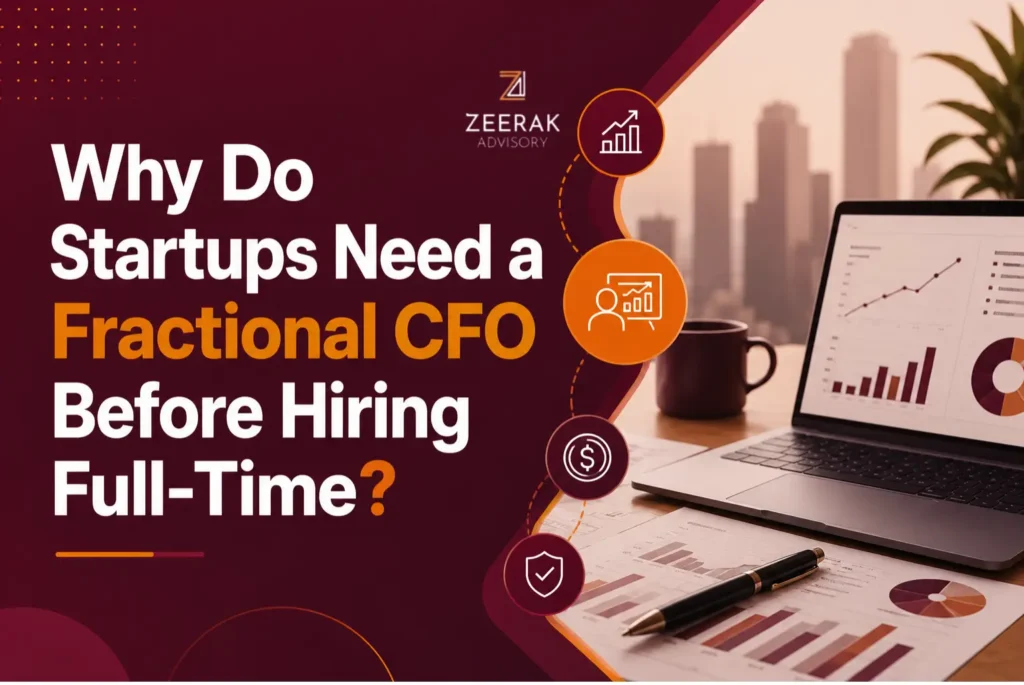
Startups need a fractional CFO before hiring full-time because financial complexity often arrives before the company has the budget, workload, or maturity for a permanent CFO.
A startup may not need a full-time finance executive in the pre-seed, seed, or early Series A stage. The startup still needs CFO-level thinking for runway, burn rate, financial forecasting, fundraising, investor reporting, tax planning, and financial controls.
For example, a seed-stage SaaS company with 8 months of runway may not need a permanent CFO. The company still needs burn rate control, a hiring forecast, investor updates, and a fundraising model before the next round. A startup fractional CFO gives founders that financial leadership without the fixed salary, benefits, equity, recruiting cost, and long-term commitment of a full-time CFO.
Mercury, NOW CFO, and CFO Selections all connect fractional CFO support with cash flow management, financial forecasting, fundraising readiness, board reporting, financial systems, and investor communication. The strongest opportunity for founders is not only hiring finance help. The stronger decision is hiring the right level of finance leadership at the right stage.
What Is a Fractional CFO for Startups?
A fractional CFO for startups is a part-time financial executive who helps founders manage runway, burn rate, forecasting, fundraising, investor reporting, and strategic finance without hiring a full-time CFO.
This role is also called a part-time CFO for startups, outsourced CFO for startups, virtual CFO for startups, or startup CFO advisor. The service model can vary, but the goal stays the same: give founders better financial visibility before decisions become expensive.
A bookkeeper records transactions. An accountant handles tax and compliance. A controller manages accounting accuracy. A startup finance leader uses financial data to guide future decisions.
A fractional CFO helps answer questions such as:
- How many months of runway does the startup have?
- What is the current burn rate?
- Can the company afford the next 3 hires?
- When should the startup raise capital?
- Are the financials ready for investor due diligence?
- Which KPIs should the board see each month?
- Is the company ready for a full-time CFO?
- Is growth improving or weakening unit economics?
Why Hire a Fractional CFO Before a Full-Time CFO?
A startup should hire a fractional CFO before a full-time CFO when it needs strategic financial leadership but does not yet need a permanent executive every day.
Full-time CFOs are expensive. They also require the right stage, internal finance team, investor expectations, and long-term operating need. A fractional CFO reduces hiring risk because the startup can get senior finance support for specific outcomes first.
For many founders, the immediate need is not a permanent CFO. The immediate need is a better financial model, clearer cash flow forecast, investor-ready reporting, stronger startup finance strategy, and a plan for when to hire full-time.
This makes fractional CFO support a bridge between founder-led finance and permanent executive finance leadership.
What Does a Fractional CFO Do for a Startup?
A fractional CFO does 10 core jobs for startups: runway planning, burn rate management, financial forecasting, fundraising support, investor reporting, KPI tracking, unit economics analysis, financial controls, tax planning coordination, and finance team planning.
| Startup CFO Responsibility | Startup Impact |
| Runway planning | Shows how long cash lasts |
| Burn rate management | Controls spending without stopping growth |
| Startup financial forecasting | Connects revenue, hiring, expenses, and funding |
| Investor-ready financial model | Supports fundraising and due diligence |
| Startup board reporting | Improves investor and board communication |
| KPI dashboard | Tracks growth, margin, and capital efficiency |
| Unit economics analysis | Shows whether growth is profitable or expensive |
| Financial controls | Reduces risk as the startup scales |
| Startup tax planning | Aligns CPA advice with strategy and compliance |
| Finance hiring plan | Defines when to hire accountant, controller, or full-time CFO |
The value is practical. Founders get better visibility into cash, hiring, fundraising, pricing, reporting, and financial risk before those decisions become urgent.
How Does a Fractional CFO Improve Cash Flow and Runway?
A fractional CFO improves startup cash flow forecasting by tracking cash inflows, cash outflows, customer collections, payroll, vendor payments, debt, taxes, hiring plans, and funding timelines.
Runway is one of the most important startup finance metrics.
Startup runway = cash balance ÷ net monthly burn.
For example, a startup with $600,000 in cash and $100,000 in net monthly burn has 6 months of runway. If monthly burn increases to $150,000, runway drops to 4 months.
A startup finance advisor helps founders understand how each decision affects runway. Hiring 5 people, increasing ad spend, delaying collections, or buying software can change the funding timeline.
A strong runway plan includes:
- Current cash balance
- Gross burn
- Net burn
- Revenue forecast
- Hiring plan
- Payroll forecast
- Vendor payments
- Tax payments
- Funding timeline
- Downside scenario
- 13-week cash forecast
The goal is not to stop spending. The goal is to spend with timing, evidence, and control.
How Does a Fractional CFO Manage Burn Rate?
A fractional CFO manages startup burn rate by separating necessary growth spend from wasteful or poorly timed expenses.
Burn rate management is not only cost-cutting. A startup still needs to invest in product, sales, hiring, and customer acquisition. The finance leader’s job is to connect spending with measurable outcomes.
A CFO-level burn review usually includes:
- Payroll by department
- Software subscriptions
- Marketing spend
- Contractor costs
- Cloud infrastructure costs
- Sales commissions
- Customer acquisition cost
- Revenue per employee
- Vendor contracts
- Hiring plan timing
For example, a SaaS startup may discover that cloud cost per customer is rising faster than recurring revenue. An eCommerce startup may find that ad spend increases sales but weakens contribution margin. A services startup may find that hiring improves capacity but lowers cash runway faster than expected.
How Does a Fractional CFO Help with Fundraising?
A fractional CFO helps with startup fundraising by preparing investor-ready financial models, funding assumptions, use-of-funds plans, runway analysis, KPI dashboards, and due diligence materials.
Investors want a clear financial story. Founders need to explain how much capital they need, how the money will be used, how long the capital will last, and which milestones the business can reach before the next raise.
A fractional CFO services for startups engagement often includes:
- Startup financial model
- Revenue assumptions
- Hiring forecast
- Cash runway analysis
- Burn rate forecast
- Use-of-funds plan
- Investor KPI dashboard
- Board reporting template
- Due diligence preparation
- Pitch deck financials review
This support helps founders answer investor questions with evidence instead of estimates.
How Much Does a Fractional CFO Cost for Startups?
Fractional CFO cost for startups depends on stage, scope, meeting frequency, fundraising needs, reporting complexity, and deliverables.
Early-stage advisory may cost less when the startup only needs runway planning, burn rate review, and a basic financial model. The cost increases when the engagement includes investor-ready financial models, board reporting, fundraising support, due diligence preparation, tax planning coordination, and financial controls.
| Startup Need | Typical Scope | Cost Level |
| Light advisory | Runway review, monthly finance call, basic forecast | Lower |
| Fundraising support | Financial model, use-of-funds plan, investor reporting | Medium |
| Ongoing CFO support | Budgeting, KPI dashboard, board reports, cash planning | Medium to high |
| Advanced startup finance | Due diligence, controls, tax planning, department budgets | Higher |
A full-time CFO creates a larger fixed cost because the startup pays salary, benefits, possible equity, recruiting cost, and long-term commitment. A fractional CFO gives founders senior finance support before the company is ready for that permanent hire.
What CFO Support Does Each Startup Stage Need?
Startup CFO needs change by funding stage, team size, investor expectations, and financial complexity.
| Startup Stage | CFO Need | Best Finance Support |
| Pre-seed | Basic cash tracking, entity setup, early budget | Accountant + light CFO advisory |
| Seed stage | Runway, burn rate, financial model, fundraising prep | Fractional CFO for startups |
| Series A | Board reporting, budget, KPI dashboard, investor updates | Startup fractional CFO + controller support |
| Series B | Multi-department planning, controls, audit readiness | Fractional CFO or VP Finance |
| Growth stage | Daily executive finance leadership | Full-time CFO |
A CFO for early-stage startup companies should focus on cash, forecasting, tax setup, and funding readiness. A CFO for seed stage startup companies should improve runway planning and investor financials. A CFO for Series A startup companies should build stronger reporting, controls, and board-level planning.
Fractional CFO vs Full-Time CFO: Which Should a Startup Choose?
A startup should choose a fractional CFO when it needs strategic finance support without daily executive coverage. A startup should choose a full-time CFO when finance leadership becomes permanent, complex, and cross-functional.
| Factor | Fractional CFO | Full-Time CFO |
| Best stage | Pre-seed to Series A or early Series B | Later Series B, Series C, or growth stage |
| Cost | Lower fixed cost | Higher salary, benefits, and possible equity |
| Commitment | Flexible | Permanent |
| Speed | Faster to start | Slower hiring process |
| Scope | Defined priorities and deliverables | Full finance department ownership |
| Risk | Easier to adjust or replace | Higher hiring risk |
| Best use | Runway, burn, fundraising, board reporting | Full executive finance leadership |
The choice is not only about cost. The better question is whether the startup needs full-time executive ownership or targeted CFO-level support for the current stage.
When Should a Startup Hire a Fractional CFO?
A startup should hire a fractional CFO when finance questions become too complex for founder spreadsheets, bookkeeping, or basic accounting.
Common signs include:
- Cash runway is under 12 months.
- The company plans to raise funding in the next 6 months.
- Monthly close takes too long.
- Forecasts are not matching actual results.
- Investors ask financial questions founders cannot answer confidently.
- Hiring decisions need scenario modeling.
- Burn rate is increasing faster than revenue.
- The board needs monthly reporting.
- Financial controls are weak.
- A full-time CFO is too expensive or premature.
This is usually the point where founder-led finance becomes risky. The company needs better financial planning before decisions become harder to reverse.
What KPIs Should a Startup CFO Track?
A startup KPI dashboard should track growth, cash efficiency, unit economics, retention, margin, and runway.
| Startup Type | CFO-Level KPIs |
| SaaS | MRR, ARR, churn, CAC, LTV, CAC payback, burn multiple |
| Marketplace | GMV, take rate, buyer retention, seller retention, contribution margin |
| eCommerce | Gross margin, inventory turnover, ROAS, cash conversion cycle |
| Service startup | Utilization, revenue per employee, gross margin, backlog |
| Healthcare startup | Collections, denial rate, revenue cycle, payroll ratio |
| AI startup | Cloud cost per customer, gross margin, ARR, model usage cost |
Startup unit economics matter before scaling because growth can hide weak margins. A startup can increase revenue and still destroy cash if CAC, churn, gross margin, or payback period is unhealthy.
How Does a Fractional CFO Build Startup Financial Infrastructure?
A fractional CFO builds startup accounting infrastructure by improving financial systems, reporting workflows, chart of accounts, internal controls, and finance processes.
Startup financial infrastructure includes:
- Clean chart of accounts
- Monthly close process
- Cloud accounting system
- Payroll system
- Expense approval process
- Bill payment workflow
- Revenue recognition process
- KPI dashboard
- Board reporting template
- Tax filing calendar
- Investor data room
Clean infrastructure makes forecasting more reliable. It also helps the startup prepare for fundraising, board reporting, due diligence, tax planning, and future audits.
Can a Fractional CFO Help With Startup Tax Planning?
A fractional CFO helps with startup tax planning by coordinating CPA advisory, payroll tax planning, entity structure, R&D credit review, state tax obligations, and cash reserves for tax payments.
This is an important gap in many startup CFO articles. Fundraising and financial modeling matter, but tax planning also affects runway and investor readiness.
Startup tax planning may include:
- Entity structure review
- Payroll tax coordination
- Founder compensation planning
- R&D tax credit review
- Multi-state tax exposure
- Contractor vs employee classification support
- Sales tax review
- Tax cash reserve planning
- Year-end CPA coordination
A CPA-led fractional CFO model gives founders stronger alignment between tax compliance, cash flow, and startup finance strategy.
What Should a Fractional CFO Deliver in the First 90 Days?
A fractional CFO should deliver a financial health review, cash runway analysis, 13-week cash forecast, KPI dashboard, operating budget, board reporting template, and finance roadmap in the first 90 days.
| Timeline | Key Deliverables |
| Days 1-30 | Financial health review, cash position, burn rate, 13-week forecast, accounting data review |
| Days 31-60 | Operating budget, startup financial model, KPI dashboard, board reporting template |
| Days 61-90 | Budget vs actual review, internal controls, investor reporting package, finance roadmap |
This 90-day roadmap gives founders measurable progress. It also helps the company decide whether the fractional CFO scope is enough or whether the startup needs a controller, VP Finance, or full-time CFO later.
When Should a Startup Move From Fractional CFO to Full-Time CFO?
A startup should move from fractional CFO to full-time CFO when finance leadership becomes daily, cross-functional, investor-facing, and operationally permanent.
Signs include:
- Series B or later stage
- Multiple finance team members
- Complex revenue recognition
- Frequent board and investor reporting
- Multi-state or international operations
- Debt financing, audit, or M&A activity
- Large enterprise contracts
- CFO scope exceeds fractional capacity
A fractional CFO before full-time CFO is often the bridge. The startup gets immediate strategic finance support and learns what type of permanent finance leader it will need later.
Why Choose Zeerak Advisory for Startup Fractional CFO Services?
Zeerak Advisory provides CPA-led fractional CFO services for startups, outsourced CFO support, virtual CFO services, tax advisory, and strategic finance guidance for growth-stage companies across the USA.
Zeerak Advisory is built for founders who need finance leadership before hiring a full-time CFO. The team includes U.S. Certified CPAs, senior accountants, and Big Four alumni with experience in accounting, tax, financial reporting, cash flow forecasting, and business advisory.
Zeerak Advisory supports startups with:
- Startup finance strategy
- Startup financial forecasting
- Startup cash flow forecasting
- Startup runway planning
- Startup burn rate management
- Investor-ready financial model preparation
- Startup board reporting
- Startup KPI dashboard setup
- Startup unit economics review
- Startup fundraising financials
- Startup due diligence preparation
- Startup financial controls
- Startup tax planning
- Startup accounting infrastructure
- CFO advisory services for startups
Founders in major startup markets often need CFO-level support that matches local growth costs, funding activity, hiring pressure, and tax complexity. Zeerak Advisory supports companies looking for Fractional CFO Services in New York, Fractional CFO Services in Miami, Fractional CFO Services in Houston, Fractional CFO Services in Dallas, Fractional CFO Services in Chicago, Fractional CFO Services in Los Angeles, Fractional CFO Services in San Francisco, and Fractional CFO Services in Austin.
A startup in New York or San Francisco may need stronger investor reporting and runway planning because operating costs are high. A startup in Austin, Dallas, Houston, Miami, Chicago, or Los Angeles may need outsourced CFO support to manage hiring, pricing, funding, tax planning, and growth decisions without committing to a full-time CFO.
FAQs About Fractional CFOs for Startups
Why do startups need a fractional CFO?
Startups need a fractional CFO to manage runway, burn rate, forecasting, fundraising, investor reporting, financial controls, and growth decisions before hiring a full-time CFO.
When should a startup hire a fractional CFO?
A startup should hire a fractional CFO when cash runway, fundraising, hiring, investor reporting, or forecasting becomes too complex for founder-led finance.
Is a fractional CFO better than a full-time CFO for startups?
A fractional CFO is better for many early-stage startups because the company gets senior financial leadership without the cost and commitment of a full-time CFO.
How much does a fractional CFO cost for startups?
Fractional CFO cost for startups depends on scope, stage, complexity, meeting frequency, fundraising needs, and reporting deliverables.
Can a fractional CFO help with fundraising?
A fractional CFO helps with fundraising by preparing financial models, investor reports, runway forecasts, due diligence materials, and use-of-funds plans.
Can a fractional CFO help with runway planning?
A fractional CFO helps with runway planning by forecasting cash, tracking burn rate, modeling hiring plans, and aligning spending with funding milestones.
Does a startup need a CFO before Series A?
A startup may need CFO support before Series A if it is raising capital, managing burn, building investor financials, or preparing board-level reporting.
What is the difference between a startup controller and CFO?
A startup controller manages accounting accuracy and close processes. A startup CFO leads forecasting, strategy, fundraising support, cash planning, and investor reporting.
Conclusion
Startups need a fractional CFO before hiring full-time because they need financial strategy before they need a permanent finance executive.
A fractional CFO for startups helps founders manage cash flow, runway, burn rate, fundraising, investor-ready financial models, startup board reporting, KPI dashboards, unit economics, tax planning, and financial controls.
The role gives startups senior finance leadership at the right stage. Founders get clearer numbers, better decisions, stronger investor communication, and a lower-risk path toward a future full-time CFO.
For many early-stage and growth-stage companies, the right sequence is simple: clean accounting first, fractional CFO support next, full-time CFO later.